Essential Elements of a High-Performing Nephrology Billing Department
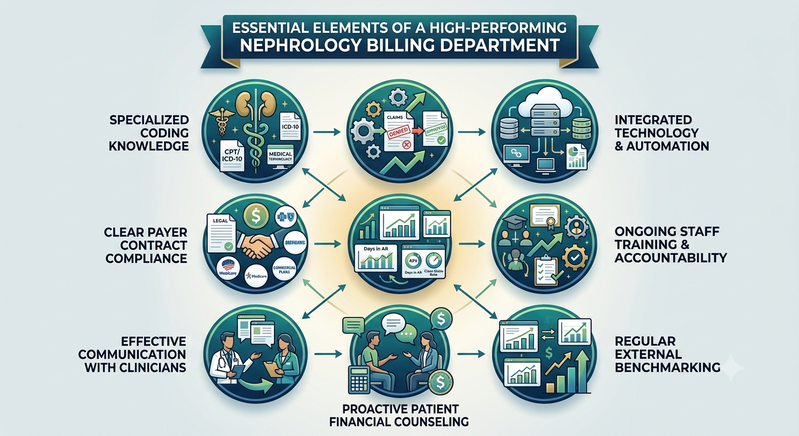
Nephrology practices face unique revenue cycle challenges. Chronic kidney disease management, dialysis services, and complex coding requirements demand a specialized approach to medical billing. A high-performing nephrology billing department does not happen by accident. It requires deliberate structure, clear processes, and ongoing education. This post outlines the core elements that separate effective billing operations from struggling ones.
Specialized Coding Knowledge
Nephrology coding involves distinct challenges. Chronic kidney disease stages, dialysis treatments, and vascular access procedures use specific CPT and ICD-10 codes. Errors in staging or modality selection lead to denials and delayed payments. A strong billing department invests in continuous coding education. Staff must understand the difference between hemodialysis and peritoneal dialysis coding. They must know when to use modifier -25 for significant separately identifiable services. Without this expertise, the department cannot achieve clean claim rates above 95 percent.
Robust Denial Management Workflow
Denials are inevitable in nephrology billing. However, high-performing departments do not treat denials as isolated events. They track denial reasons by payer, procedure, and provider. They analyze patterns weekly. Common nephrology denials include medical necessity for lab tests, incorrect dialysis session counts, and missing documentation for ESRD facility claims. A dedicated denial team reviews each rejection within 48 hours. They correct and resubmit claims promptly. They also provide feedback to clinicians about documentation gaps. This proactive approach reduces denial write-offs and accelerates cash flow.
Integrated Technology and Automation
Manual processes create bottlenecks. A high-performing billing department uses practice management software integrated with electronic health records. This integration allows for automated eligibility verification, charge capture, and claim submission. For nephrology, automated calculation of dialysis treatment units prevents underbilling. Automated patient statement generation reduces administrative labor. However, technology is only as good as the data entered. The department must maintain clean master files for payers, fee schedules, and provider demographics. Regular system audits prevent claim rejects due to outdated information.
Clear Payer Contract Compliance
Nephrology practices contract with multiple payers, including Medicare, Medicaid, and commercial plans. Each payer has distinct rules for dialysis bundling, transfusion services, and E/M visit billing. A high-performing billing department maintains a payer matrix. This document outlines timely filing limits, prior authorization requirements, and reimbursement rates. The team reviews contract updates monthly. They adjust their billing logic in the practice management system accordingly. Failure to comply with payer-specific rules results in lost revenue. Compliance also reduces the risk of audits and recoupments.
Transparent Performance Metrics
You cannot improve what you do not measure. Essential metrics for nephrology billing include days in accounts receivable, clean claim rate, first-pass resolution rate, and net collection percentage. A high-performing department reviews these metrics weekly. They set targets based on industry benchmarks. For nephrology, an acceptable days in A/R is under 40. The clean claim rate should exceed 95 percent. When metrics fall below targets, the department investigates root causes. They implement corrective actions quickly. This data-driven culture drives continuous improvement.
Ongoing Staff Training and Accountability
Billing regulations change frequently. New codes, modifier updates, and payer policies appear throughout the year. A high-performing department allocates time for staff training. They schedule monthly coding workshops. They assign each staff member specific payer or task ownership. Accountability includes regular quality audits of submitted claims. Errors are treated as learning opportunities, not punishment. Staff understand that their work directly impacts practice profitability. This sense of ownership reduces turnover and improves accuracy.
Effective Communication with Clinicians
Billing does not happen in a silo. Documentation from clinicians determines code selection. A high-performing billing department establishes regular feedback loops with providers. They share denial trends related to insufficient documentation. They offer short tips on how to document dialysis start times, vascular access evaluations, and comorbidity assessments. They also inform clinicians about prior authorization requirements for expensive injectable drugs. This collaboration prevents downstream claim issues. It also saves clinician time by reducing clarification calls.
Proactive Patient Financial Counseling
Patient responsibility is growing in nephrology. High deductibles and coinsurance affect many patients. A high-performing billing department does not wait for bills to go unpaid. They verify patient benefits before service. They provide clear cost estimates for planned dialysis or procedures. They offer payment plans for high-balance accounts. They also screen patients for financial assistance programs, including manufacturer copay cards. This proactive approach improves patient satisfaction and reduces bad debt. It also lowers the administrative cost of collections.
Regular External Benchmarking
Internal metrics are useful, but external comparison provides context. A high-performing billing department participates in benchmarking surveys specific to nephrology. They compare their performance against similar practices by size, location, and patient mix. This exercise reveals blind spots. It also highlights best practices from peer departments. For example, if peers have lower denial rates for lab bundling, the department investigates their methods. Benchmarking drives strategic changes rather than reactive fixes.
In summary, a high-performing nephrology billing department combines specialized knowledge, disciplined workflows, and collaborative culture. It does not rely on a single solution. Instead, it builds a system where technology, people, and processes work together. Practices that invest in these elements see faster payments, fewer denials, and more stable revenue. They also reduce stress for administrative and clinical teams. For practices seeking to improve their revenue cycle, these elements are not optional. They are essential.
Comments
No comments yet. Be the first to comment!